
an online portal for guitarmakers, guitar enthusiasts, and students
following Natelson & Cumpiano's treatise, GUITARMAKING: Tradition & Technology

Chapter 1 - Guitar Anatomy
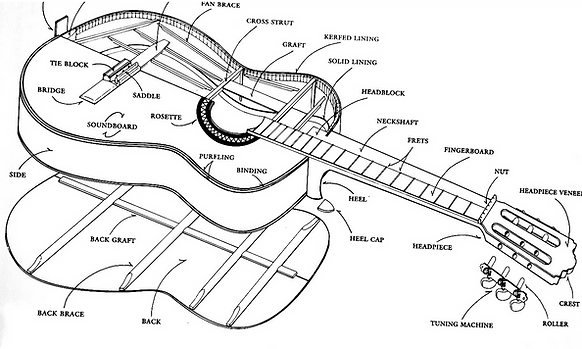
A deeper dive into the guitar's structure, neck joints, aesthetics & acoustics.
For expanded discussions on topics discussed in the chapter, click on the link buttons below.
What's the importance of "minimally adequate structure"?
This is an AI summary of Tim White's upcoming e-book, "Secret Life of the Guitar", edited by William Cumpiano.
To the uninitiated, an acoustic guitar is nothing more than a wooden box strung with wire. To a master luthier, however, it is a captivating object that has held humanity spellbound from ancient Hittite rock carvings to modern concert halls. Unlocking the power of a vibrating string requires looking past the polished mahogany and lacquer to visualize the invisible anatomy of sound. Acoustics provides a way to make this hidden world visible, tracing the transformation that turns the flick of a finger into a soul-stirring melody.
At its core, a guitar is a mechanical transformer. It does not generate energy on its own; it converts energy through a demanding physical sequence. The process begins as chemical energy stored in a musician's muscles, which converts to kinetic movement as fingers pluck a string. For a split second, that motion is held as potential energy in the stretched wire, much like a pulled archer's bow. When released, the string snaps into kinetic vibration, driving the bridge and forcing the body to vibrate, ultimately radiating acoustic energy through air pressure waves that reach our ears. Yet this transformation is an uphill battle against physical friction. The guitar is a notoriously inefficient machine, losing roughly ninety-five percent of its input energy as internal heat. Only a meager five percent crosses the finish line to become the sound we hear. After all, the guitar's form was not originally conceived by acoustical engineers but by unschooled artisans.
How these sound waves interact with the room depends heavily on the relationship between their physical size and acoustic wavelength. Their individual wavelengths are calculated by dividing the speed of sound—roughly eleven hundred feet per second—by the vibration frequency of the musical sound.
This relationship gives rise to the Size Rule, which dictates how any object projects sound. If an object is significantly smaller than the wavelength it produces, it acts as a point source, sending energy out like a tiny, pulsating sphere. If the object is similar in size to or larger than the wavelength, it functions as a broad radiating surface. This creates an interesting acoustic puzzle across the guitar's range. A high treble note vibrating at eighteen thousand hertz produces a tiny wave only three-quarters of an inch long—roughly the size of a bridge pin—allowing the guitar top to act as an expansive radiating surface. Conversely, a mid-range note around four hundred and forty hertz produces a wave two and a half feet long, matching the length of the guitar body itself.
The true mystery arises at the bottom of the instrument's register. A low G note vibrates at roughly one hundred hertz, generating an eleven-foot sound wave—a physical length comparable to the side of a small house. According to the Size Rule, a two-foot wooden box should be completely incapable of projecting an eleven-foot wave. The guitar solves this through a clever internal air-pumping mechanism that functions much like a rum jug. At these low frequencies, the wooden soundboard does not bend in complex patterns; instead, the top and back plates move together as a single, unified unit. The air trapped inside the body, particularly near the soundhole, acts like a heavy, physical piston. As the wooden plates flex, this air plug bobs in and out, pumping the internal volume to generate massive low-frequency pressure waves. To make this mechanism work, the luthier must carefully position the bridge away from nodal lines—the stationary fulcrums of the vibrating top where no motion occurs—ensuring the soundboard can freely drive the air piston.
Because of these shifting physical dynamics, a guitar operates as three entirely different instruments depending on the register being played. In the lowest range, spanning ninety to five hundred hertz, it acts as a monopole (an idealized, infinitely small sphere that expands and contracts uniformly in all directions--often called "breathing" or "piston-like" motion) air pump where the body and air cavity couple together to maximize bass output.
In the mid-range, between five hundred and fifteen hundred hertz, the instrument transitions into a multipole regime--an acoustic source created by combining two or more monopoles positioned close together, operating at specific phase relationships. Because adjacent monopoles flex or vibrate in opposite directions, sound waves can partially cancel each other out, making multipoles less efficient at radiating low-frequency sound compared to monopoles. Here, the soundboard divides into distinct vibrating sections separated by stationary nodal lines. Because adjacent sections flex in opposite directions, their sound waves partially cancel each other out, making the output highly directional.
Finally, in the high treble range--from fifteen hundred to five thousand hertz, the individual physical resonances of the wood become so dense that they overlap, merging into a continuous vibrational landscape known as the resonance continuum. This dense cloud of overtones creates the shimmering, detailed voice unique to a high-performance guitar.
The ultimate destination for these complex vibrations is human perception, which acts as a biased acoustic filter rather than a neutral measuring device. Human ears are astonishingly sensitive, capable of detecting eardrum displacements as tiny as a single angstrom—the width of a hydrogen atom. Evolutionary biology has wired our hearing to be most acute in the voice formant range between one thousand and four thousand hertz, the exact frequencies that carry the emotional nuances of human speech. Consequently, we judge an instrument's soul and tonal beauty based almost entirely on how it performs within this specific window. Furthermore, our perception of volume is logarithmic rather than linear. A three-decibel increase in sound energy represents a doubling of physical power, yet human ears perceive this as merely a subtle shift. To make a guitar sound twice as loud, its acoustic output must increase by ten decibels—a tenfold jump in efficiency that is physically impossible for a passive wooden box.
Understanding these acoustic realities prevents luthiers from falling for well-intentioned construction traps. A master builder recognizes that true success does not come from clever design tricks, but from managing the fundamental balance between structural integrity and dynamic sensitivity. The instrument must be built strong enough to withstand over one hundred and fifty pounds of continuous string tension, yet remain flexible enough to unleash the rich potential of the resonance continuum.
Why are guitar soundboxes tapered?
Acoustic soundboxes are traditionally tapered, but there’s no historical justification for this common feature. Over the years, we’ve developed several plausible theories or rationales for the tapering of the body depth of the acoustic guitar’s soundbox—that is, making it shallower at the neck block (front) than at the end block (tail). These theories are undoubtedly speculative, as no one remembers the justification given by the earliest luthiers who determined its form. Here are some of the more thoughtful modern rationales:
Helmholtz Resonance Fine-Tuning: The lower air volume in the upper bout reduces overall internal cavity volume while maintaining a large lower-bout surface area. This keeps the primary air resonance tuned to an optimal bass frequency without producing a muddy or overly boomy response.
Standing Wave Suppression: Non-parallel interior planes created by the longitudinal taper (along with back-plate arching) break up standing waves and internal reflections between the top and back. This prevents severe resonant peaks and dead spots in the mid-range.
Arm Reach & Shoulder Comfort: Reducing depth at the upper bout brings the top of the body closer to the player's torso. This decreases the reach angle of the right arm over the body, reducing shoulder fatigue during extended playing.
Fretboard Sightlines & Upper Access: A shallower depth near the neck block allows easier access to higher fret positions and improves sightlines down the fingerboard.
Neck Joint Stability: A shallower depth at the heel reduces the leverage exerted by string tension on the neck block, maintaining joint alignment over time without adding excess weight to the upper body block.
To understand the art of high-performance guitar making, one must first appreciate the profound physical paradox sitting at the heart of the instrument. A guitar is a wooden box tasked with enduring a massive, relentless physical load—a static tension between one hundred and two hundred pounds of force exerted by its tuned strings. Left unchecked, this crushing load would soon transform a delicate instrument into a wall decoration. Yet, to generate music, that same wooden box must respond to the faintest, most microscopic kinetic fluctuations: the dynamic tension of an oscillating string. This dynamic signal is a chorus of mathematical information, carrying the rich, natural harmonic series that our ears perceive as tone.
The fundamental dilemma of the luthier is balancing these two opposing forces. If a builder over-engineers the instrument's soundbox with unnecessarily heavy bracing and thick wooden walls to easily survive the static load, the excess mass becomes a problem. This excessive structure chokes the soundbox's response to the string's delicate vibrations, absorbing the subtle harmonic energy and dissipating it as useless heat within the wood, long before it can ever be projected into the surrounding air as audible sound.
Master luthiers navigate this tension through the principle of the "minimally adequate structure." This approach treats the physical instrument not as a rigid container, but as an acoustic gate that can either suppress or liberate the string's potential. Every physical component of the instrument operates according to its willingness to bend and vibrate in sympathy with specific sound waves. Where the structure is light, compliant, and responsive, it presents an "open door" to the string's frequencies, allowing kinetic energy to transfer cleanly into the soundboard and radiate outward into the room. Where the structure is overly rigid, non-compliant, or dense, it presents a "closed door." The higher harmonics knock against this rigid barrier in vain, unable to excite the heavy wood, and the musical signal dies. By systematically paring away every unnecessary gram of material until the structure is just strong enough to withstand the string tension without collapsing—with only minimal distortion, the artisan maximizes the overall compliance of the entire system. The instrument transforms into a sensitive, low-resistance boundary designed to let the string speak with maximum freedom. Because it is the string which is providing the full spectrum of available sound.
Attempting to scientifically engineer every single nuance of an instrument's acoustic response is an exercise in futility. While basic computer modeling can map simple, low-frequency vibrations below two hundred hertz, the higher-frequency spectrum behaves like an impenetrable, overlapping cloud of resonances. These higher overtones contain the true character, warmth, and expressive personality of the guitar's voice, yet their physical behavior inside a wooden box is far too chaotic and complex for pure quantitative analysis to predict. When builders become overly obsessed with measuring every frequency, reading digital spectra, and trying to force specific scientific targets onto the wood, they often produce lifeless, sterile instruments. They fall into the trap of over-analysis, losing sight of the organic nature of the materials. Traditional master luthiers, working with intuitive methods passed down across generations, consistently achieve brilliant results precisely because they respect the inherent unpredictability of natural timber rather than trying to force it into a rigid, calculated mold.
This realization leads to a profound shift in how we view the role of the luthier: the master builder is not a sound sculptor who forces an intentional tone upon the wood, but a curator of transparency whose primary objective is to get out of the way. The true beauty of an acoustic guitar's tone is not actually invented by the builder; it already exists, fully formed, in the natural physics of the vibrating string. A plucked string vibrates in a mathematically perfect cascade of fundamental notes and overtones—a harmonious signal that the human brain naturally finds comforting and beautiful. The luthier does not need to (or able to) manufacture tone from scratch or artificially manipulate the wood to achieve an invented result. Instead, the highest ambition in guitar construction is fidelity: creating a physical architecture so transparent, lightweight, and responsive that it acts as an invisible medium. By employing a minimally adequate structure, the builder solves the stress problem just enough to ensure the instrument survives, while leaving the physical pathway entirely open for the string's uninhibited, natural voice to flourish. That is a sensible path to success.