
an online portal for guitarmakers, guitar enthusiasts, and students
following Natelson & Cumpiano's treatise, GUITARMAKING: Tradition & Technology

Sources of materials, tools & supplies
Click here for sources of tools
Click here for sources of supplies
Sources of guitar making materials
Here are all the parts of the guitar. Click on the part’s name to find recommended materials for them, their starting dimensions, and suggestions on where and how to obtain them.
Back (see Sets)
Bridge Patch
Bridge Pins
End Graft
End Pin
Fingerboard
Frets
Headpiece Veneer
Headpiece Laminations
Heelcap
Linings (solid)
Linings (kerfed)
Neck
Nut
Pickguard
Purflings
Rosette lines
Rosette marquetry rings
Saddle
Sets (Steel-string guitar)
Sets (Classical guitar)
Sides (see Sets)
Side Dots (SS only)
Shell Inlay (SS only)
Soundboard
Soundboard braces
Tailblock
Truss Rod (SS only)
Truss Rod Spline
Tuning Machines
Tuning Pegs
Dimensions and sources for your guitar's back braces
Steel-string guitar:
5/16 X 9/16 X 14 inches (two required)
1/2 X 3/4 X 17 inches (two required)

Finished brace blank dimensions
Classical guitar:
5/16 X 1/2 X 12 inches (two required)
5/16 x 1/2 X 13 inches (one required)
5/16 x 1/2 X 15 inches(one required)

Finished brace blank dimensions
Sources

Back braces can be purchased commercially as pre-dimensioned sticks or as larger, solid billets of stock which can be further processed into dimensioned braces with hand or power tools at a considerable cost savings. Most any uniformly-textured, straight-grained softwood or medium-density hardwood devoid of any swords or flaws can be used. However, spruce and mahogany (Honduras and African) are the traditional back brace species for both classical and steel-string guitars. Spanish cedar (cedrella, spp.) is favored for classical guitars. Pacific red cedar (Thuja plicata), basswood (Buxus sempervirens), and alder (Alnus spp.) is also used. An excellent, economical, but little-known alternative material is poplar (Populus) which is widely available in most hardwood lumberyards.
Pre-dimensioned back bracing and brace blanks
-
Stewart-MacDonald (shaped braces and dimensioned brace blanks)
-
J.S. Bogdanovich (dimensioned mahogany back brace blanks)
Bracing stock
-
Stewart-MacDonald
-
J.S. Bogdanovich
-
Alaska Specialty Woods (rough split-spruce brace wood slabs in boxes)
-
Pacific Rim Tonewoods (milled split-spruce brace wood billets)
-
Exotic Wood Zone (milled Spanish cedar, mahogany, basswood, alder
brace wood billets) -
Maderas Barber (milled spruce, mahogany,
Dimensions and sources for your guitar's back grafts
Steel-string guitar:
5/8" wide strips 1/8" thickness
totalling 18" in length
Classical guitar:
1/2" wide strips 1/8" thickness
totalling 18" in length
Sources

Back graft material is traditionally processed from scrap 1/8" thick strips of mahogany or spruce, trimmed so that the grain direction runs perpendicular to the strip's longest dimension. However, virtually any convenient scrap timber material of appropriate cross-section can be used, including basswood, African mahogany, Spanish cedar, or poplar.
Pre-dimensioned back graft material
-
Stewart-MacDonald (shaped braces and dimensioned brace blanks)
-
J.S. Bogdanovich (dimensioned mahogany back brace blanks)
Back graft stock
-
Stewart-MacDonald (cut from neck blank material)
-
J.S. Bogdanovich (cut from neck blank materials)
-
Alaska Specialty Woods (rough split-spruce brace wood slabs in boxes)
-
Pacific Rim Tonewoods (milled split-spruce brace softwood billets)
-
Exotic Wood Zone (milled Spanish cedar, mahogany, basswood, alder
brace wood billets) -
Maderas Barber (milled spruce, mahogany, and other species
Dimensions and sources for your guitar's back stripe
Steel-string guitar:
minimum length required: 21''
Classical guitar:
minimum length required: 21''
Guitar back stripes can be as simple as a single natural or dyed veneer line separating the two back plate halves, or they can be a multi-layer composite of veneer lines, shell inlay strips, or strips of mosaic-tile marquetry.
If the marquetry strips to be inlaid are as thick or thicker (or if the veneer lines are taller) than the back plate halves, and if their integrity appears sound, you can simply glue them right in between the book matched back-plate halves when gluing those plates together.
If the strips are thinner than the back-plate halves, You need to glue the book matched halves together first, and then route a slot down the seam no deeper than 2/3 of the back plate's thickness.
Veneer lines can be slit individually from sheets of natural or dyed veneer, or more conveniently, pre-laminated strips of different widths and compositions such as black-white-black strips, or white-black-white strips can be commercially purchased from several luthier-supply merchants.
Straight shell inlay strips can also be inlaid between back halves, usually bordered by laminated veneer-line strips. These have to be inlaid into a slot routed into the seam of a pre-joined back plate, precisely at the same depth as the thickness of the shell strips, so that none of the colorful material is removed during the subsequent leveling process
Shell inlay for back stripes
-
See entry for purfling materials.
Dyed or natural veneer-lines or sheets
-
Stewart-MacDonald (black and white fiber and maple laminations in various combinations and dimensions--and also tinted veneer sheets
-
Maderas Barber (black-white-black-white sycamore 1 meter squared laminate sheets and tinted wood veneer sheets
-
Allied Luthierie (black-white-black fiber or maple) laminate strips
-
Wood Cycle Products (small US-based natural veneer supplier)
-
Exotic Wood Zone
Marquetry back stripes
-
Allied Luthierie
-
Stewart-MacDonald (
-
Exotic Wood Zone
-
Maderas Barber
-
RC Tonewoods
-
E.L. Henson Inlay and Design
-
Gurian Instruments
-
Inlay Product World

Dimensions and sources for your guitar's bindings
Steel-string guitar:
(4) 3/16" × 3/32" x 32" min.
maple, rosewood, mahogany, celluloid or ABS strips
Classical guitar:
(4) 3/16" x 3/32" x 30" rosewood strips
Sources
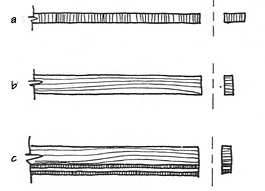
(See (a) above):
Our major source of wood guitar binding strips are strips trimmed from the surplus width of side slats from guitar sets, or from the un-bent mate of the side set that was broken while bending or perhaps from the side set that was second-rate, flawed or otherwise unsuitable for a good guitar. This source is ideal for 3/32"-thick strips, and we always try to strip, process and bend at least one ir two extras, in case one breaks while bending. We strip ours on a tablesaw, using the thinnest, smallest diameter circular saw blade we could obtain (see fret saws).
(See (b) above)
If you're making a series of guitars, or just want to stock up on binding strips, it helps to have access to an abrasive planer, This allows you to sand 30" lengths of common hardwoods such as maple, poplar or basswood into 3/16'' sheets and then strip them on a tablesaw to 3/32" binding strips.
(See (c) above)
You can save yourself a lot of time and trouble if before you strip the material described in (b) above, you glue one or more sheets of contrasting veneers below it, yielding laminated binding strips which allow you to bind the guitar with bindings that have the side purfling lines already included.
Pre-dimensioned wood binding strips
-
Stewart-Macdonald (plain and laminated maple, koa, ebony, rosewood , walnut or bloodwood binding strips)
-
Allied Luthierie (plain and laminated binding strips)
-
Pacific Rim Tonewoods (maple, koa, ebony or rosewood binding strips)
-
Maderas Barber (plain and laminated rosewood, purple heart, sycamore)
Pre-dimensioned binding strips (thermoplastic)
-
Stewart-MacDonald (plain and laminated white and ivoroid
-
Allied Luthierie (white and ivoroid)
-
Pacific Rim Tonewoods (milled split-spruce brace wood billets)
-
Exotic Wood Zone (white ABS plastic
Dimensions and sources for your guitar's bridge
Steel-string guitar:
1½" x 6"
Classical guitar:
11/8" × 71/2"
Sources

If you don't have the $$ to easily obtain dark, exotic hardwoods in planks that you can then resew and extract 3/8'' thick bridge-size billets--then you must opt to obtain dimensioned bridge blanks, usually at premium prices, from luthier suppliers.
Alternatively, you can opt to source the blanks from more economical, less exotic materials walnut, cherry, padouk, or purpleheart, and still obtain good results.
Pre-dimensioned back graft material
-
Stewart-MacDonald (shaped braces and dimensioned brace blanks)
-
J.S. Bogdanovich (dimensioned mahogany back brace blanks)
Back graft stock
-
Stewart-MacDonald (cut from neck blank material)
-
J.S. Bogdanovich (cut from neck blank materials)
-
Alaska Specialty Woods (rough split-spruce brace wood slabs in boxes)
-
Pacific Rim Tonewoods (milled split-spruce brace softwood billets)
-
Exotic Wood Zone (milled Spanish cedar, mahogany, basswood, alder
brace wood billets) -
Maderas Barber (milled spruce, mahogany, and other species